


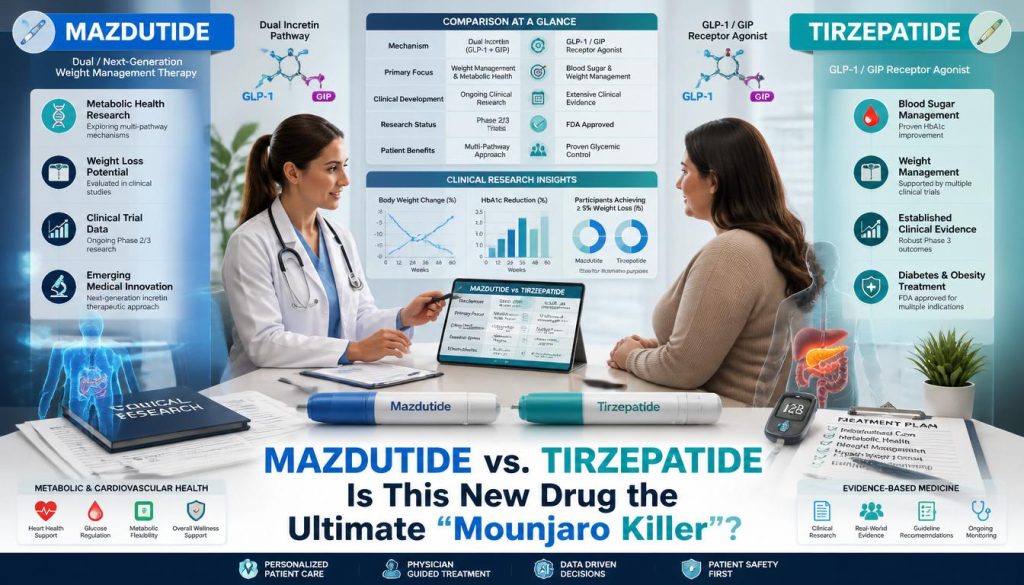
The landscape of metabolic pharmacotherapy is moving at a staggering pace. A few years ago, the introduction of selective glucagon-like peptide-1 (GLP-1) receptor agonists fundamentally changed how the medical community approaches chronic weight management. Shortly after, tirzepatide arrived and shifted the paradigm further by targeting two metabolic pathways simultaneously, achieving weight reduction numbers previously seen only through bariatric procedures.
Now, a new molecule named mazdutide is capturing the attention of obesity specialists, clinical researchers, and patients alike. As early data from its late-stage clinical trials surfaced, headlines quickly emerged labeling this investigational compound as the ultimate “Mounjaro killer.” It is an enticing media narrative, the idea of a breakthrough newcomer poised to completely dethrone the world’s most powerful dual-agonist therapy.
However, in obesity medicine, terms like “killer” often oversimplify highly nuanced clinical realities. Evaluating whether mazdutide truly challenges tirzepatide requires looking beyond the pharmaceutical marketing, unpacking the distinct cellular mechanisms at play, and carefully analyzing the trial data to separate scientific promise from industry hype.
What Is Tirzepatide?
To establish a baseline for comparison, it is necessary to first understand the current clinical benchmark. Tirzepatide is a synthetic peptide that represents the first widely available multi-receptor incretin therapy. Instead of focusing solely on the well-known GLP-1 pathway, tirzepatide is a dual agonist that simultaneously stimulates two distinct nutrient-stimulated hormone receptors:
- GLP-1 (Glucagon-Like Peptide-1) Receptors: Located primarily in the brainstem, hypothalamus, and gastrointestinal tract. Activation delays gastric emptying, enhances central satiety signals, and dampens reward pathways associated with food cravings.
- GIP (Glucose-Dependent Insulinotropic Polypeptide) Receptors: Abundantly expressed in adipose (fat) tissue, the pancreas, and the central nervous system. In the pancreas, GIP works in tandem with GLP-1 to maximize glucose-dependent insulin secretion. In fat tissue, GIP appears to improve lipid buffering capacity and lower systemic inflammation, creating a unique metabolic synergy that maximizes weight loss while mitigating some of the gastrointestinal side effects common to pure GLP-1 agents.
Tirzepatide is fully approved by the U.S. Food and Drug Administration (FDA) and available in commercial pharmacies under two brand names depending on the patient’s primary diagnosis. It is sold as Mounjaro for the treatment of type 2 diabetes to improve glycemic control, and as Zepbound for chronic weight management in adults with obesity or overweight with at least one weight-related condition.
What Is Mazdutide?
Mazdutide is an innovative, once-weekly injectable dual-receptor co-agonist originally discovered by Eli Lilly and Company and subsequently licensed to Innovent Biologics for clinical development and commercialization, primarily in East Asian territories.
As a next-generation obesity treatment, mazdutide is designed as a synthetic peptide based on the structure of oxyntomodulin, a naturally occurring gut hormone released after meals that simultaneously activates both GLP-1 and glucagon receptors.
While still unknown to many Western patients because it is actively making its way through international pipelines, mazdutide achieved a massive milestone by securing full regulatory approval from China’s National Medical Products Administration (NMPA) under the brand name Xinermei for chronic weight management in adults with obesity or overweight. Shortly after, it also received approval in China for blood sugar management in adults with type 2 diabetes.
This regulatory milestone made mazdutide the very first dual GLP-1/glucagon receptor agonist to hit the global market for obesity treatment, positioning it as a highly sophisticated contender in the evolving metabolic drug pipeline.
How Do Mazdutide and Tirzepatide Work Differently?
The core scientific distinction between these two medications lies in which specific metabolic levers they pull. While both molecules share the GLP-1 foundation to promote fullness and slow digestion, they diverge completely when selecting their secondary target
| Medication | Receptor Combination | Primary Metabolic Strategy | How It Achieves Weight Loss |
| Tirzepatide | GLP-1 + GIP | Caloric Restriction & Adipose Optimization | Maximizes appetite suppression while simultaneously improving insulin sensitivity and how fat cells (adipose tissue) store energy. |
| Mazdutide | GLP-1 + Glucagon | Caloric Restriction & Elevated Energy Expenditure | Pairs appetite suppression with a direct metabolic accelerator, mimicking the fasting state to burn more calories at rest and target liver fat. |
Tirzepatide: The GLP-1 / GIP Strategy
Tirzepatide’s dual-action strategy relies heavily on the synergistic relationship between GLP-1 and GIP to shut down appetite and optimize how fat tissue responds to energy storage. GIP acts as a metabolic stabilizer, enhancing insulin sensitivity directly in fat cells and making it easier for the body to manage blood sugar fluctuations without causing severe gastrointestinal distress.
Mazdutide: The GLP-1 / Glucagon Strategy
Mazdutide exchanges the GIP component for direct glucagon receptor activation. In traditional physiology, glucagon is primarily known as a hormone that raises blood sugar when fasting. However, when administered chronically in combination with GLP-1, glucagon activation initiates entirely different metabolic benefits:
- Elevated Energy Expenditure: Glucagon directly signals the body to increase resting energy expenditure, meaning it helps burn more calories even at rest, combating the drop in metabolic rate that typically occurs during prolonged calorie restriction.
- Hepatic Lipid Mobilization: Glucagon receptors are heavily concentrated in the liver. Activating them triggers lipolysis, the breakdown of stored fats, accelerating the clearance of intrahepatic fat and altering lipid metabolism directly at the cellular level.
Weight Loss Results Comparison
When evaluating weight-loss drugs, clinical trial results provide the objective data needed to cut through commercial hype. Because mazdutide and tirzepatide have not yet been compared in large-scale, head-to-head clinical trials, researchers must analyze their individual trial programs while accounting for differences in study design and patient populations.
Tirzepatide Clinical Trial Efficacy
Tirzepatide’s weight-loss data is anchored by the global SURMOUNT clinical trial program.
- In the foundational SURMOUNT-1 trial, which followed adults with obesity or overweight without type 2 diabetes over a 72-week period, participants taking the maximum 15 mg weekly dose achieved an average weight reduction of 20.9% to 22.5% of their total body weight.
- This data set established tirzepatide as one of the most effective non-surgical weight management options in medical history.
Mazdutide Clinical Trial Efficacy
Mazdutide’s performance data comes primarily from the GLORY registration trials conducted in Chinese adult populations.
- GLORY-1 (4 mg and 6 mg doses): In this 48-week phase 3 trial evaluating adults with obesity or overweight, participants taking the 6 mg dose achieved a mean body weight reduction of approximately 11% to 14%.
- GLORY-2 (9 mg high-dose formulation): To assess the drug’s upper limits, researchers initiated studies on a higher 9 mg dose for individuals with moderate-to-severe obesity. The 60-week data revealed a mean weight reduction of 18.55% in the overall cohort.
- Non-Diabetic Subgroups: Among the subset of participants without type 2 diabetes in the GLORY-2 trial, the average weight loss reached 20.08% at week 60, with researchers noting that the weight loss curve had not yet reached a plateau by the conclusion of the study.
Critical Nuances in Cross-Trial Interpretation
When comparing tirzepatide’s 22.5% against mazdutide’s 20.1% non-diabetic high-dose results, it is easy to assume they are virtually identical. However, an elite clinical analyst must note that mazdutide’s trials were conducted almost exclusively within Chinese populations.
East Asian populations generally present with a lower baseline Body Mass Index (BMI) but exhibit a higher proportion of visceral fat and elevated cardiometabolic risk at lower absolute body weights compared to Western cohorts. Because baseline weights were lower in the mazdutide trials, the absolute number of pounds lost differs from the heavier baseline cohorts in the global SURMOUNT trials, making direct cross-trial declarations of superiority scientifically invalid.
Blood Sugar and Diabetes Benefits
Both medications excel as comprehensive metabolic treatments, demonstrating powerful efficacy in reversing insulin resistance and correcting glycemic markers.
Tirzepatide in Glycemic Management
Tirzepatide’s performance in type 2 diabetes management is verified across the comprehensive SURPASS trial program. Due to its potent dual-incretin action, tirzepatide regularly drives HbA1c reductions exceeding 2.0% in clinical cohorts, with a substantial percentage of participants achieving complete normalization of blood glucose profiles (HbA1c below 5.7%) without increasing the risk of hypoglycemia.
Mazdutide in Glycemic Management
Mazdutide’s diabetes data stems from the DREAMS trial program. In its completed registration studies, mazdutide met all primary endpoints, demonstrating profound glucose control.
By utilizing the glucagon pathway alongside GLP-1, mazdutide alters hepatic glucose output while simultaneously upgrading peripheral insulin sensitivity through weight loss. To benchmark its performance against standard therapies, researchers launched the DREAMS-3 trial, a Phase 3 study directly comparing mazdutide against semaglutide in Chinese adults with type 2 diabetes, highlighting its status as a top-tier glucose-lowering agent.
Side Effects Comparison
The tolerability profiles of both therapies reflect their specific interactions with the endocrine system. While they share the typical characteristics of incretin class medications, their secondary receptor choices create distinct secondary effects.
The Glucagon vs. GIP Tolerability Profile
The mechanical difference between the two drugs shows up clearly in their broader systemic profiles:
- Tirzepatide (GIP Effect): Because GIP appears to exert an anti-emetic (nausea-reducing) effect in the central nervous system, it helps offset some of the raw gastrointestinal stress driven by high-dose GLP-1 activation.
- Mazdutide (Glucagon Effect): Glucagon receptor stimulation can introduce unique physiological changes. In clinical settings, mazdutide has been associated with a transient, mild increase in resting heart rate during early titration, alongside specific changes in total energy output. Furthermore, because glucagon acts directly on the liver, clinicians closely monitor hepatic enzyme profiles during long-term therapy.
Is Mazdutide Really a “Mounjaro Killer”?
With the scientific and clinical data established, we can directly answer the primary question: Is the “Mounjaro killer” label scientifically justified, or is it merely media hyperbole?
The label is largely premature and exaggerated. To understand why, look at the specific balance between what makes mazdutide highly promising and what remains unproven.
Why the Innovation Is Groundbreaking
Mazdutide is not just a copycat medication. The excitement surrounding it is legitimate because its dual GLP-1/glucagon mechanism provides a different biological pathway to weight management.
By actively stimulating energy expenditure and accelerating the clearance of liver fat, it addresses the metabolic deceleration that often derails long-term weight management. For individuals with severe fatty liver complications or those whose metabolisms slow down dramatically on standard GLP-1s, mazdutide offers an entirely new therapeutic angle.
Why the “Killer” Label Is Incorrect
For a drug to actively “kill” or replace a dominant therapy like Mounjaro, it must demonstrate undeniable superiority, broader utility, or clearer safety in a head-to-head setting. Mazdutide currently faces clear clinical limitations:
- Lack of Broad Demographic Validation: While its 20% weight reduction in high-dose Chinese cohorts is outstanding, large-scale, global phase 3 data across diverse, multi-ethnic Western populations is still missing.
- No Direct Comparison Data: Without direct, head-to-head clinical testing against tirzepatide, stating that one compound outperforms the other is scientifically unsupported.
- Real-World Longevity: Tirzepatide has been used in millions of patients globally for years, establishing a well-documented safety and real-world efficacy profile. Mazdutide is just entering its initial phases of real-world commercial utilization.
Availability and Regulatory Status
Understanding where these drugs stand from a regulatory perspective is essential for managing immediate clinical expectations.
Tirzepatide Availability
Tirzepatide is approved globally, fully commercialized, and available at retail pharmacies throughout the United States, Europe, and other international markets. While global demand has occasionally caused supply chain constraints, it remains a fully accessible option for immediate prescription use.
Mazdutide Availability
Mazdutide is approved by the NMPA in China for chronic weight management and type 2 diabetes. However, it does not possess FDA approval in the United States, nor has it cleared the European Medicines Agency (EMA) pipeline.
There are currently no active New Drug Applications (NDA) or Investigational New Drug (IND) files open for mazdutide in Western markets, meaning it is not legally available to be prescribed, compounded, or distributed by Western healthcare networks.
Who Might Benefit Most From Each Medication?
As personalized obesity medicine advances, clinicians focus on selecting the specific chemical profile that matches a patient’s precise health background.
Optimal Profiles for Tirzepatide
- Patients requiring immediate access to a highly effective, FDA-approved anti-obesity or diabetes treatment.
- Individuals seeking a treatment backed by extensive real-world usage data across diverse global populations.
- Patients who struggle with severe nausea and may benefit from the tolerability advantages provided by GIP co-agonism.
Intended Profiles for Mazdutide (Upon Global Expansion)
- Patients with significant metabolic dysfunction-associated steatotic liver disease (MASLD) who require rapid reduction of liver fat.
- Individuals who experience a severe drop in resting metabolic rate during traditional calorie restriction.
- Patients within Asian demographics whose metabolic complications occur at lower absolute BMI thresholds, matching the exact population studied in the GLORY trials.
The Evolving Landscape of Obesity Medicine
The comparison between mazdutide and tirzepatide highlights a broader shift in modern endocrinology. Obesity is no longer viewed as a simple failure of willpower or a basic calorie problem; it is recognized as a complex, multi-hormone metabolic disorder.
The first wave of treatments relied on single-target therapies like semaglutide. The second wave introduced dual-target platforms like tirzepatide (GLP-1/GIP) and mazdutide (GLP-1/glucagon). The third wave is already moving into triple-agonist compounds like retatrutide, which combine all three pathways into a single molecule.
This rapid innovation means the future of metabolic health will not be about finding one single “winner” drug to replace all others. Instead, the focus will be on personalized medicine, equipping physicians with a diverse toolkit of multi-receptor compounds so they can select the precise hormonal combination required by each patient’s unique metabolic profile.
Structural Comparison
This table outlines how mazdutide and tirzepatide compare across core clinical and regulatory categories based on current medical literature.
| Feature | Tirzepatide (Mounjaro / Zepbound) | Mazdutide (Xinermei) |
| Drug Class | Dual GIP / GLP-1 Receptor Agonist | Dual GLP-1 / Glucagon Receptor Agonist |
| Hormone Targets | GLP-1 and GIP Receptors | GLP-1 and Glucagon Receptors |
| Mechanism | Appetite suppression paired with fat tissue stabilization | Appetite suppression paired with increased resting energy expenditure |
| Weight Loss Data | ~20.9% to 22.5% reduction at 72 weeks (SURMOUNT-1) | ~18.5% to 20.1% reduction at 60 weeks (GLORY-2) |
| Diabetes Benefits | Profound HbA1c lowering and blood sugar normalization | Significant glycemic control; currently being evaluated vs. semaglutide |
| Side Effects | Mostly temporary GI symptoms; lower nausea due to GIP | Temporary GI symptoms; requires tracking of resting heart rate |
| Approval Status | Fully FDA approved for Diabetes (2022) and Obesity (2023) | Fully NMPA approved in China (2025); Not FDA approved |
| Availability | Available globally via commercial prescription networks | Available exclusively within Chinese medical networks |
| Research Maturity | High; validated by extensive real-world and post-market data | Moderate; comprehensive Phase 3 data in East Asian cohorts |
| Future Potential | Established cornerstone of modern obesity pharmacotherapy | First-in-class glucagon co-agonist validating multi-pathway therapy |
Frequently Asked Questions
Mazdutide is an innovative, once-weekly injectable dual-receptor co-agonist designed to activate both the GLP-1 and glucagon receptors simultaneously. It mimics the natural gut hormone oxyntomodulin to suppress appetite while increasing energy expenditure.
Current data does not support calling mazdutide superior to tirzepatide. While mazdutide shows exceptional weight loss results in Chinese clinical trials, it has not been tested in broad, global head-to-head clinical studies against tirzepatide to establish superior efficacy or safety.
No. Mazdutide is not approved by the U.S. Food and Drug Administration (FDA) for weight loss or type 2 diabetes, and it is not available for prescription or compounding use in the United States.
The term is an online marketing phrase driven by early trial data showing that mazdutide’s weight loss results approached a 20% average reduction, similar to numbers achieved by tirzepatide (Mounjaro). However, this label is premature given mazdutide’s localized availability and lack of global head-to-head clinical trials.
In separate clinical trials, high-dose tirzepatide demonstrated an average weight reduction of up to 22.5% over 72 weeks, while high-dose mazdutide demonstrated up to a 20.1% average weight reduction over 60 weeks in non-diabetic cohorts. A definitive comparison requires direct head-to-head clinical trials.
Mazdutide activates the GLP-1 receptor to slow digestion and signal fullness to the brain, while simultaneously activating the glucagon receptor to increase resting metabolic rate and accelerate the clearance of fat from the liver.
Yes, mazdutide is fully approved in China for the treatment of type 2 diabetes, demonstrating significant capabilities in lowering HbA1c and improving systemic insulin sensitivity in clinical trials.
Yes, mazdutide is a GLP-1 receptor agonist, but it belongs to a specialized sub-category known as dual-receptor agonists because it targets the glucagon receptor alongside the GLP-1 receptor.
No, there are no published large-scale head-to-head clinical trials directly comparing mazdutide against tirzepatide.
The future centers on multi-receptor targeting. The development path from single-hormone mimics like semaglutide to dual-hormone platforms like tirzepatide and mazdutide indicates that combining multiple metabolic pathways is the preferred approach for treating complex metabolic diseases.
Conclusion:
The comparison between mazdutide and tirzepatide reveals two highly effective, sophisticated therapies. Tirzepatide remains the global gold standard for non-surgical weight management, supported by broad regulatory approval, diverse clinical trial data, and extensive real-world usage. Mazdutide stands out as an exciting innovation, establishing itself as the world’s first approved GLP-1/glucagon dual agonist and proving that recruiting the glucagon pathway is a highly viable strategy for metabolic care.
The idea of a “Mounjaro killer” makes for a compelling headline, but clinical reality favors a diverse selection of approved therapies over a single dominant option. If you are exploring medical weight management or considering adjustments to your current treatment plan, the most effective next step is to consult a qualified healthcare professional. They can evaluate your specific metabolic health, discuss currently available evidence-based options, and help you build a safe, personalized strategy tailored to your long-term goals.
Sources & Medical References
- The New England Journal of Medicine (NEJM): Tirzepatide Once Weekly for the Treatment of Obesity (SURMOUNT-1 Study Design and Efficacy Data). https://www.nejm.org/doi/full/10.1056/NEJMoa2206038
- The Lancet Diabetes & Endocrinology: Efficacy and safety of mazdutide in Chinese adults with obesity or overweight: a randomised, double-blind, placebo-controlled, phase 3 trial (GLORY-1 Outcomes).
https://www.thelancet.com/journals/landia/article/PIIS2213-8587(24)00154-1/fulltext - PubMed / Springer Drugs: Mazdutide: First Approval (Comprehensive Regulatory History and Approval Conditions under the NMPA). https://pubmed.ncbi.nlm.nih.gov/41028652/
- U.S. Food and Drug Administration (FDA): FDA Approves Novel Medication for Chronic Weight Management (Zepbound Official Clinical Labeling). https://www.fda.gov/news-events/press-announcements/fda-approves-novel-medication-chronic-weight-management
- Innovent Biologics Corporate Registry: Supplementary Application for the 9 mg Dosage of Mazdutide for Long-Term Weight Management Accepted for Review (GLORY-2 Trial 60-Week High-Dose Statistics).
https://en.innoventbio.com/InvestorsAndMedia/PressReleaseDetail?key=564