


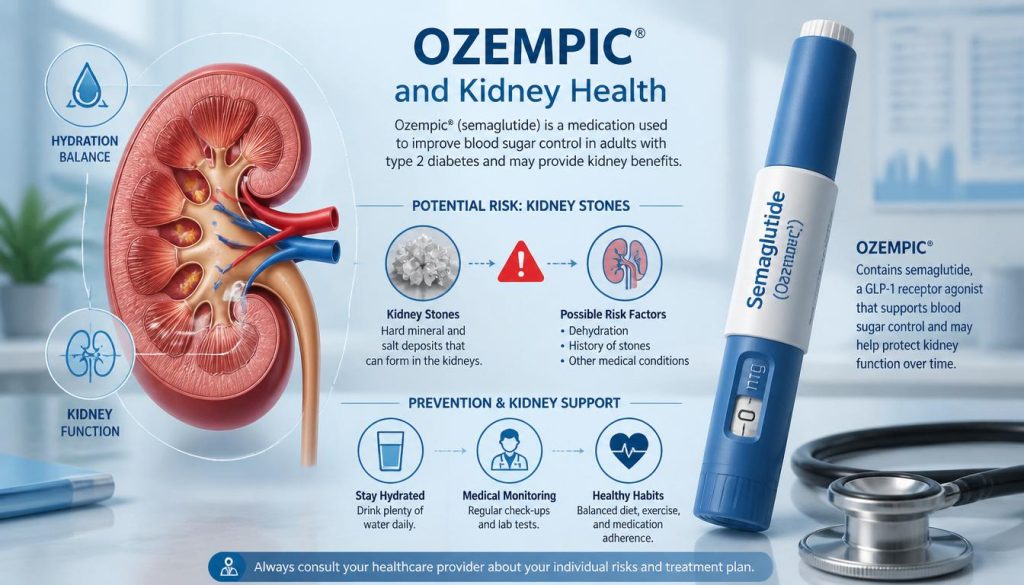
Weight loss can feel life-changing until a new symptom suddenly sends you into a late-night Google spiral. For many people starting Ozempic, the excitement of the scale moving is often met with a wave of unexpected anxiety. You might be feeling a dull ache in your side or noticing you aren’t drinking as much as you used to, leading to the one question that keeps you up: Is this medication hurting my kidneys?
When people search for Ozempic and kidney stones, they aren’t looking for complex medical jargon. They want to know if the medication is safe, why they feel different, and how to prevent complications like dehydration or kidney pain. The truth is that while Ozempic (semaglutide) is actually being hailed for its potential to protect the kidneys in many patients, the way your body reacts to the drug; specifically through nausea, vomiting, and rapid weight loss, can create a perfect storm for kidney stones if you aren’t careful.
This guide is designed to bridge the gap between clinical data and the real-world experience of being on a GLP-1 medication. Whether you are currently dealing with Ozempic side effects or just want to be proactive about your renal health, we’re here to help you navigate the science with empathy and clarity.
What Ozempic does inside the body
Ozempic is a GLP-1 receptor agonist. Its primary job is to mimic a hormone that tells your pancreas to release insulin and your brain to feel full. However, it also slows down gastric emptying. This is why you feel full longer, but it’s also the reason for the “Ozempic burp” and the potential for nausea. By changing how you process food and your desire to drink, Ozempic indirectly shifts your internal fluid balance.
How Ozempic affects hydration levels
One of the most overlooked Ozempic side effects is a decreased thirst drive. Because you feel “full,” your brain often forgets to signal that you are thirsty. Combined with nausea and vomiting, this can lead to Ozempic dehydration. When you are dehydrated, your kidneys have to work harder to filter waste, concentrating your urine; which is exactly how stones begin to form.
Why dehydration may increase kidney stone risk
Kidney stones are essentially tiny crystals that form when your urine becomes too concentrated with minerals like calcium or oxalate. Think of it like a saltwater solution: if the water evaporates, the salt stays behind and hardens. Dehydration and kidney stones go hand-in-hand because without enough water to flush those minerals out, they sit in the kidney and crystallize.
How rapid weight loss changes kidney health
Losing weight quickly is the goal for many, but rapid weight loss and kidney stones have a long-documented history. When you burn fat quickly, your body releases substances that can increase the amount of uric acid in your blood and urine. If you aren’t flushing your system with high volumes of water, this uric acid can lead to stones.
Comparison: Ozempic Side Effects vs. Dehydration Symptoms
| Side Effect / Symptom | Ozempic (Standard) | Dehydration (Warning) |
| Nausea | Common, usually mild to moderate | Can be a sign of electrolyte loss |
| Thirst | Often decreased (dangerous) | Extreme thirst or dry mouth |
| Urine Color | Pale yellow (Normal) | Dark, amber, or “honey” colored |
| Fatigue | General “tired” feeling | Dizziness, lightheadedness, or confusion |
| Muscle Cramps | Rare | Common sign of electrolyte imbalance |
What symptoms should not be ignored
It is easy to dismiss a backache as “muscle strain from the gym,” but kidney pain while on Ozempic needs a second look. If you experience sharp, stabbing pain in your “flank” (the side of your back below the ribs) that radiates toward your groin, this is a classic sign of a stone.
When to Seek Emergency Care
- Inability to urinate.
- Blood in the urine (pink or red tint).
- Fever and chills accompanied by back pain.
- Persistent vomiting where you cannot keep any fluids down for 24 hours.
How nausea and vomiting impact kidney function
Chronic Ozempic nausea can lead to “subclinical dehydration”; a state where you aren’t thirsty enough to drink, but your kidneys aren’t getting quite enough fluid. If this progresses to vomiting, your kidney function (eGFR) can temporarily drop. This is why doctors emphasize semaglutide hydration risks during the first few weeks of dose titration.
Why electrolyte balance matters on semaglutide
Water alone isn’t always enough. When you lose weight and eat less, you also take in fewer minerals like magnesium, potassium, and sodium. An electrolyte imbalance and Ozempic can lead to the “Ozempic fatigue” many patients report.
How to lower kidney stone risk while using Ozempic
The good news is that kidney stones are highly preventable.
- Sip, Don’t Chug: Since you feel full, drinking a whole glass of water might feel nauseating. Keep a straw nearby and take small sips all day.
- Add Electrolytes: Use a sugar-free electrolyte powder once a day to ensure your mineral levels stay stable.
- Watch the Protein: High-protein diets (popular with Ozempic users to prevent muscle loss) can increase calcium excretion. Balance your protein with plenty of fiber and water.
Hydration Recommendations Table
| Activity Level | Daily Fluid Goal | Tip |
| Sedentary | 64–80 oz | Set a phone timer to drink every hour. |
| Active/Exercise | 90–120 oz | Drink 16 oz before you start your workout. |
| Dealing with Nausea | 4 oz every 30 mins | Use ice chips or very cold water. |
What current research says about Ozempic and kidneys
Interestingly, the latest data from 2024 and 2025 (including the FLOW trial) suggests that GLP-1 kidney health outcomes are actually overwhelmingly positive for most. In patients with type 2 diabetes and chronic kidney disease (CKD), semaglutide has been shown to reduce the risk of kidney failure. The “risk” of stones is a manageable side effect of the weight loss process, not a sign that the medication is toxic to the renal system.
Medical Myths vs. Facts
- Myth: Ozempic causes permanent kidney damage.
- Fact: While AKI (Acute Kidney Injury) has happened, it is almost always due to severe dehydration from vomiting, not the drug itself.
- Myth: Everyone on Ozempic gets kidney stones.
- Fact: Stones are relatively rare and usually happen in those with a prior history or those who stop drinking water.
- Myth: You should stop taking Ozempic if your side hurts.
- Fact: You should call your doctor. It could be a stone, or it could just be muscle ache or constipation.
Real-World Scenarios
The “Success” Story:
Sarah lost 30 lbs in 3 months. She felt “fine” but was only drinking one coffee and a small bottle of water a day. She developed a dull ache in her side. After a telehealth visit, she realized she was severely dehydrated. She started an electrolyte routine, and the pain vanished within 48 hours.
The “Prior History” Scenario:
Mark had kidney stones five years ago. When he started Ozempic, his doctor put him on a specific hydration plan and monitored his urine calcium levels. By being proactive, Mark lost 50 lbs without a single stone recurrence.
Frequently Asked Questions
Ozempic does not directly cause kidney stones, but it can increase your risk indirectly. Side effects like nausea and vomiting can lead to dehydration, and rapid weight loss can change your urine chemistry, both of which are primary triggers for stones.
The best way to protect your kidneys is through consistent hydration (aiming for 2-3 liters of fluid daily), monitoring for signs of dehydration, and ensuring you don’t lose weight too fast without medical supervision.
Yes. Severe dehydration can lead to Acute Kidney Injury (AKI). If you are experiencing persistent vomiting or can’t keep fluids down, contact your healthcare provider immediately.
Watch for dark-colored urine, a significant decrease in how much you urinate, swelling in your ankles or face, and sharp “flank pain” in your mid-to-lower back.
Yes, and in many cases, it is now prescribed specifically to help protect the kidneys in diabetic patients. However, if you have Stage 4 or 5 CKD, your doctor will need to monitor you much more closely.
Conclusion
Your journey toward better metabolic health shouldn’t be overshadowed by fear. Ozempic and kidney health can coexist beautifully as long as you remain a “proactive hydrator.” By understanding that stones are a byproduct of thirst and weight loss speed, not the medication itself, you can take control of your health.
If you are feeling anxious about your symptoms, don’t sit in the dark. Reach out to your healthcare provider, grab a glass of water, and remember that you are doing the hard work of transforming your life. We are just here to make sure your kidneys stay as healthy as the rest of you.
Are you experiencing persistent nausea or flank pain?
Consult with your prescribing physician or a nephrologist to ensure your hydration and electrolyte levels are optimized for your specific needs.