

While you are sitting in your living room in Miami or Seattle, scrolling through a telehealth website at 11:00 PM. You have done the research and feel that a GLP-1 medication like Ozempic might be the right step for your type 2 diabetes management or weight loss journey. However, as you look at the provider profiles, you notice many are listed as Nurse Practitioners or NPs rather than Medical Doctors.
Confusion sets in. You might wonder if an NP has the legal authority to write this specific prescription. Social media comments provide mixed advice, and some forums suggest you must see a specialist physician to get insurance approval. The fear of wasting money on a consultation that cannot result in a valid prescription is real. You want to move forward safely and legally, but the complex web of US healthcare regulations makes a simple question feel overwhelming.
The good news is that the healthcare landscape in the United States has evolved. Whether you are in a major hub like New York or a smaller community, accessing high quality care through an advanced practice provider is often the most efficient path to treatment.
Can a Nurse Practitioner Prescribe Ozempic
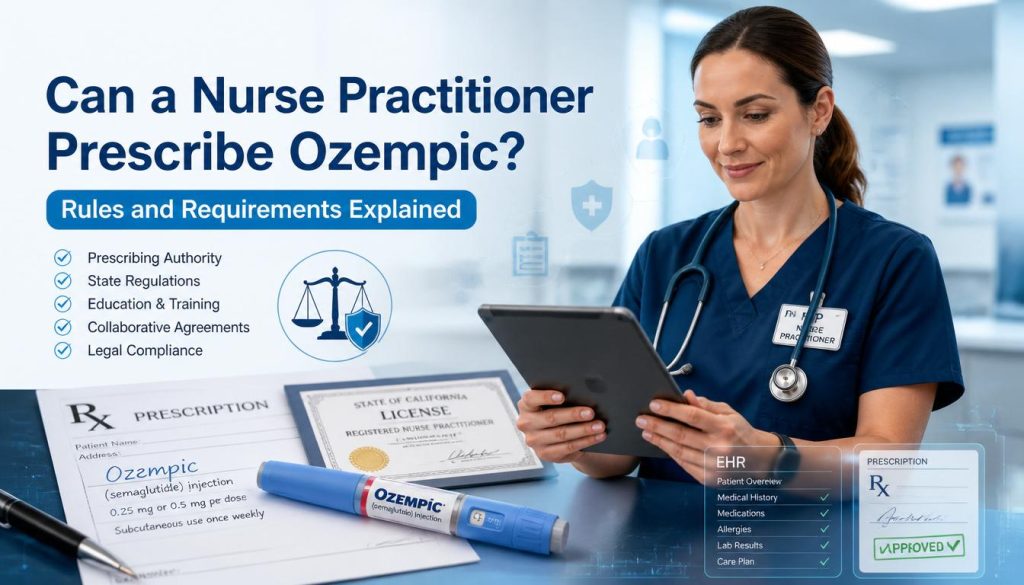
Yes, licensed nurse practitioners can prescribe Ozempic in most US states. An NP is an advanced practice registered nurse who can evaluate patients, order lab tests, and prescribe medications including semaglutide. Their ability to prescribe independently or with physician supervision depends on specific state practice laws where the patient is located.
What is a nurse practitioner and what can they prescribe
A nurse practitioner is an advanced practice registered nurse who has completed graduate level education, such as a Master of Science in Nursing or a Doctor of Nursing Practice. They undergo extensive clinical training that prepares them to function as primary care providers.
In the American healthcare system, NPs play a vital role in managing chronic conditions. Their prescribing authority often includes:
- Preventative medications for heart health and blood pressure.
- Chronic disease treatments for conditions like type 2 diabetes and asthma.
- Metabolic health tools including GLP-1 medications like Ozempic, Wegovy, and Mounjaro.
- Weight management therapies for patients meeting specific medical necessity criteria.
NPs are trained to provide a holistic approach to care, which is particularly beneficial for obesity treatment where lifestyle changes and medication must work in harmony.
How nurse practitioner prescribing rules differ across the United States
Prescribing authority is not uniform across the country. Each state Board of Nursing sets the scope of practice for NPs. Understanding these differences is key to knowing what to expect during your appointment.
State Practice Authority Comparison
| Practice Category | Description | Common States |
| Full Practice | NPs can evaluate, diagnose, and prescribe independently. | Washington, New York, Nevada, Maine |
| Reduced Practice | NPs require a collaborative agreement with a physician for some tasks. | New Jersey, Pennsylvania, Ohio |
| Restricted Practice | NPs require career-long supervision by a physician to prescribe. | Texas, Florida, Georgia, California |
In cities like Houston or Atlanta, your NP might work closely with a collaborating physician. In Seattle or San Francisco, they may operate a fully independent clinic. Regardless of the state, the clinical evaluation process for Ozempic remains focused on safety and medical necessity.
What patients need to qualify for an Ozempic prescription
Getting a prescription for Ozempic involves more than just a request. An NP will conduct a thorough clinical evaluation to ensure you meet the eligibility requirements.
- Type 2 Diabetes Diagnosis: Ozempic is FDA-approved specifically for the treatment of type 2 diabetes.
- BMI Thresholds: For weight loss, many providers look for a Body Mass Index of 30 or higher, or 27 with a weight-related comorbidity like high blood pressure.
- Medical History Review: The NP will check for contraindications, such as a personal or family history of medullary thyroid carcinoma or Multiple Endocrine Neoplasia syndrome type 2.
- Laboratory Testing: You may need blood work to check your A1C levels, kidney function, and pancreatic health.
It is important to note that while Ozempic and Wegovy both contain semaglutide, Wegovy is the version specifically FDA-approved for chronic weight management. A nurse practitioner can help determine which medication fits your specific health profile.
Can telehealth nurse practitioners prescribe Ozempic online
The rise of telehealth has made it significantly easier to connect with a nurse practitioner from the comfort of home. This is a legal and regulated way to receive care, provided the platform follows strict guidelines.
- Identity Verification: Legitimate platforms must verify your identity to prevent fraud.
- State Licensing: The NP must be licensed in the state where you are physically located at the time of the visit. For example, if you live in Chicago, your provider must hold an Illinois license.
- Medical Screening: You will complete a comprehensive intake form and participate in a video or phone consultation.
- Prescription Routing: If you qualify, the NP sends the prescription to a licensed US pharmacy.
Telehealth prescribing for semaglutide is a standard practice in 2026, offering a convenient alternative to traditional in-person visits in crowded cities like Los Angeles or Dallas.
How insurance approval works when a nurse practitioner prescribes Ozempic
Insurance coverage is often the biggest hurdle for patients. Whether your prescription comes from an NP or a physician, the insurance company will likely require a process called prior authorization.
Insurance Requirement Checklist
- Verification of Diagnosis: Documentation proving you have type 2 diabetes.
- Step Therapy: Proof that you have tried other lower-cost medications like Metformin without success.
- Clinical Notes: Evidence of your current BMI and any co-existing health conditions.
- Formulary Status: Checking if Ozempic is on your specific plan tier.
Wellcare and other major insurers have specific criteria for GLP-1 medications. If your NP provides detailed documentation of medical necessity, the chances of approval increase. If a claim is denied, your NP can often assist with the appeals process by providing additional clinical data.
Nurse practitioner vs physician prescribing for Ozempic
When it comes to Ozempic, there is no clinical difference in the medication you receive whether it is prescribed by an NP or an MD.
- Evaluation: Both providers use the same FDA guidelines and clinical data to determine eligibility.
- Access: Many patients find they can secure an appointment with a nurse practitioner much faster than with a specialist endocrinologist.
- Follow-up Care: NPs often have more availability for the monthly check-ins required to monitor side effects and adjust dosages.
- Insurance: Most insurance companies recognize NP signatures on prior authorization forms as equivalent to physician signatures.
What people get wrong about nurse practitioners and Ozempic prescriptions
There are several common myths that can prevent patients from seeking the care they need.
- Myth: NPs are not real doctors so the prescription is less valid.
- Fact: NPs are highly trained medical professionals with legal prescribing authority.
- Fact: NPs are highly trained medical professionals with legal prescribing authority.
- Myth: Insurance only covers Ozempic if a specialist prescribes it.
- Fact: Primary care NPs prescribe Ozempic every day with full insurance support.
- Fact: Primary care NPs prescribe Ozempic every day with full insurance support.
- Myth: Every online Ozempic ad is a scam.
- Fact: While you must be cautious, many reputable telehealth companies employ licensed NPs to provide legitimate care.
Why medical supervision still matters with Ozempic treatment
Ozempic is a powerful medication that affects your metabolic system. It is not a DIY treatment. Continuous oversight from a healthcare provider is essential for several reasons.
- Side Effect Management: Common issues like nausea or digestive discomfort need professional guidance.
- Dose Escalation: You typically start at a low dose of 0.25 mg and increase gradually. An NP ensures this happens at the right pace for your body.
- Blood Sugar Monitoring: If you have diabetes, your NP will need to monitor how Ozempic interacts with your other medications to prevent hypoglycemia.
- Nutritional Support: Success with GLP-1 medications is highest when paired with the nutritional advice an NP can provide.
Why confusion around Ozempic prescribing is extremely common
The rapid growth of GLP-1 medications has outpaced public understanding of healthcare roles. Social media often simplifies complex medical topics, leading to the belief that these drugs are easily available over the counter or that only certain elite doctors can access them.
Furthermore, the variation in state laws means what is true for a patient in New York may not be true for a patient in Alabama. This creates a landscape of conflicting information that can leave you feeling hesitant.
Why more Americans are turning to nurse practitioners for GLP-1 care
In cities like Phoenix or Charlotte, wait times for specialists can stretch into several months. Nurse practitioners are filling this gap, providing essential access to obesity and diabetes care.
The growth of the NP role allows for:
- Faster Appointments: Reducing the time between deciding to seek help and starting treatment.
- Personalized Attention: NPs often focus heavily on patient education and lifestyle counseling.
- Telehealth Integration: NPs have been at the forefront of the virtual care revolution, making healthcare more accessible for busy professionals.
Why Wellorithm is a trusted GLP-1 access and healthcare education resource
At Wellorithm, we believe that every patient deserves clear, evidence-based information about their health options. We understand the complexities of the US healthcare system and the specific challenges of navigating GLP-1 access.
Our goal is to provide transparent guidance that helps you understand the rules of the road. We prioritize patient safety and professional integrity, ensuring you know exactly how to find a qualified licensed provider. We are committed to realistic expectations regarding insurance, eligibility, and the clinical journey of metabolic health.
Frequently Asked Questions
Yes, nurse practitioners have the legal authority to prescribe Ozempic in all 50 states, though some states require them to work under a collaborative agreement with a physician.
Yes, an NP can prescribe semaglutide for weight loss. They may prescribe Wegovy, which is FDA-approved for weight loss, or Ozempic off-label if they determine it is medically appropriate for your specific health needs.
Yes, nurse practitioners frequently prescribe Wegovy for patients who meet the BMI requirements for chronic weight management.
Yes, telehealth providers including nurse practitioners can prescribe Ozempic as long as they perform a proper clinical evaluation and are licensed in the state where the patient resides.
States like Washington, Arizona, and New York allow NPs full practice authority, meaning they can prescribe medications like Ozempic without physician oversight.
Insurance can deny a prescription based on plan coverage or a lack of medical necessity, but they generally cannot deny it simply because it was written by an NP rather than a physician.
Ozempic is FDA-approved for type 2 diabetes. While some providers prescribe it off-label for weight loss, insurance coverage is much more likely if you have a confirmed diabetes diagnosis.
You qualify by completing a medical history review, providing recent lab results, and participating in a consultation where an NP determines that you meet the clinical criteria for the medication.
Take the Next Step Toward Your Health Goals
If you are considering Ozempic, the most important thing you can do is speak with a licensed healthcare professional. Whether you choose to see a nurse practitioner in person or through a verified telehealth platform, ensure they are licensed in your state and conduct a full medical evaluation.
Understanding your insurance benefits and the specific requirements for your plan is the best way to avoid surprises. You do not have to navigate this process alone. With the right provider and the right information, you can make an informed decision that supports your long-term wellness.
Sources and References
- FDA Ozempic Prescribing Information:
https://www.accessdata.fda.gov/drugsatfda_docs/label/2021/209637s003lbl.pdf - American Association of Nurse Practitioners State Practice Environment:
https://www.aanp.org/advocacy/state/state-practice-environment - Clinical Guidelines for GLP-1 Medications:
https://diabetes.org/clinical-care/practice-guidelines - Telehealth Prescribing Regulations by State:
https://www.cchpca.org/topic/prescribing-facilitating-diagnostic-tests/ - National Council of State Boards of Nursing:
https://www.ncsbn.org/aprn-consensus-model.htm