
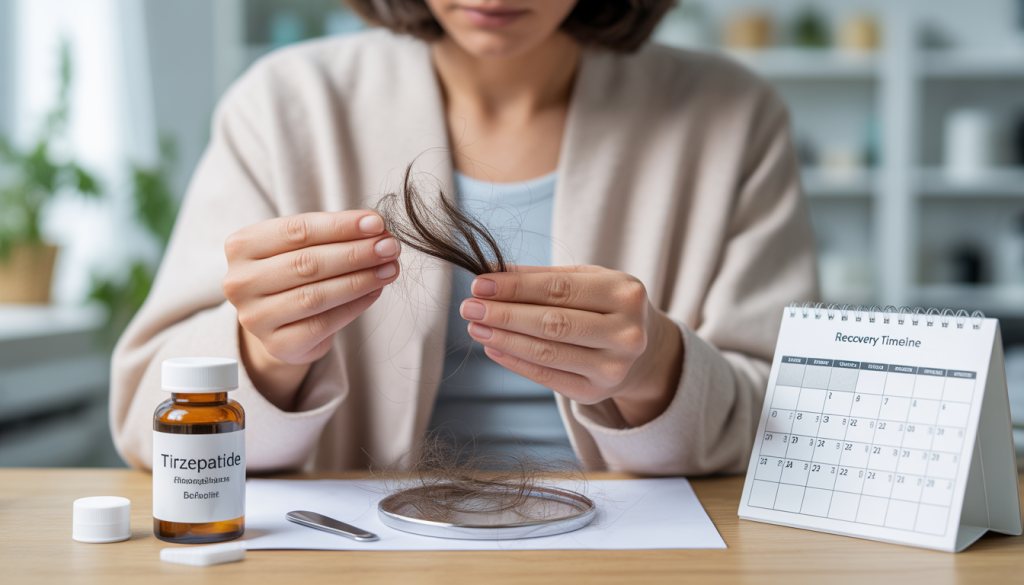
Most of the time, the fear of losing hair is actually more stressful for patients than the shedding itself. If you have noticed more strands than usual in your hairbrush after starting your weight loss journey, you are certainly not alone. In clinical settings across the USA, this is one of the most common concerns we address with patients using advanced dual-agonist therapies. It is important to start with a deep breath: your medication is not attacking your hair follicles.
What we are seeing is a biological response to rapid physical transformation. Whether you are using a GLP 1 by Wellorithm or another supervised program, understanding the mechanics of your body helps turn that anxiety into an actionable plan for recovery.
What is the clinical link between tirzepatide and hair thinning?
The direct answer is that tirzepatide does not contain any ingredients that are toxic to hair. Clinical trials for medications like Mounjaro and Zepbound did show that a small percentage of participants experienced hair thinning, but researchers noted this was a secondary effect.
The link is actually found in the metabolic shift. When you introduce a GLP 1 by Wellorithm into your system, your body enters a state of significant caloric deficit and rapid fat oxidation. For the body, this is a major physiological event. It begins to prioritize vital organs like the heart and brain over non-essential functions like the hair growth cycle. This shift is what clinicians refer to as a systemic stressor.
Why rapid weight loss triggers telogen effluvium on GLP 1 medications?
Telogen effluvium is the medical term for temporary hair shedding caused by a shock to the system. Normally, about 90 percent of your hair is in the growing phase, while 10 percent is resting. When you lose weight quickly, your body may prematurely push a larger percentage of hairs into the resting phase.
- Systemic Shock: Sudden drops in weight signal the body to conserve energy.
- The Wait Period: You usually won’t see thinning immediately. It typically starts 3 to 5 months after the initial weight loss surge.
- The Mechanism: This is a protective pause in growth, not a permanent shutdown of the follicle.
I often tell patients to think of it like a tree shedding leaves during a dry season to save its roots. The tree is still healthy, it is just adapting to a new environment.
Is hair loss from tirzepatide permanent or reversible?
The good news is that hair loss associated with GLP 1 by Wellorithm and similar therapies is almost always reversible. Because the follicle itself is not damaged, it is capable of re-entering the growth phase once the body feels it has reached a stable nutritional baseline.
Pros and Cons of the Current Metabolic Shift:
- Pro: The shedding indicates your body is responding powerfully to the weight loss therapy.
- Pro: Recovery is spontaneous once weight stabilizes.
- Con: Thinning can last several months, which affects self-esteem.
- Con: It requires patience while the hair cycle resets.
Once your weight plateaus and your nutrient absorption catches up, the shedding stops. Most people see their original fullness return within 6 to 12 months.
When to expect hair regrowth after starting GIP and GLP 1 therapy?
Timing is everything in biology. If you started your GLP 1 by Wellorithm in January and noticed shedding in April, you can typically expect to see those tiny “baby hairs” at the crown by late summer or autumn.
The recovery timeline follows a predictable path:
- Months 1 to 3: Rapid weight loss begins; hair stays in the growing phase.
- Months 3 to 6: Shedding begins as hairs move into the telogen phase.
- Months 6 to 9: Shedding slows down as the body adapts to its new weight.
- Months 9 to 12: New growth becomes visible at the scalp.
How nutritional deficiencies and protein intake impact hair density?
Hair is made primarily of a protein called keratin. When patients use a GLP 1 by Wellorithm, their appetite decreases significantly. If you are only eating 1000 calories a day and not prioritizing protein, your hair will be the first thing to suffer.
In my experience, patients who maintain a goal of 1.2 to 1.5 grams of protein per kilogram of body weight tend to have much better hair retention. It is not just about the medication; it is about what you put on your plate when you do feel like eating. Supplementing with biotin, zinc, and iron can also provide the raw materials your scalp needs to keep the factory running.
Who is most at risk for hair shedding during metabolic changes?
Not everyone will lose hair. Those most at risk usually fall into a few specific categories that we monitor closely in the clinic.
- The Rapid Losers: Patients losing more than 3 pounds per week consistently.
- The Protein Deficient: Those who struggle to meet basic daily protein requirements.
- Post-Menopausal Women: Hormonal shifts already thin the hair, and weight loss can accelerate this.
- Individuals with Low Iron: If your ferritin levels are low before you start, you are much more likely to see shedding.
How to differentiate medication side effects from stress induced shedding?
It can be tricky to tell the difference. Medication induced shedding from a GLP 1 by Wellorithm usually happens in a diffuse pattern, meaning you thin out evenly all over your head. Stress induced shedding often comes in waves or follows a major life event like a surgery or a high fever.
If you are seeing circular bald patches or your scalp feels itchy and inflamed, that is likely not the medication. That could be an autoimmune issue or a scalp infection and requires a different clinical approach. Regular check-ins with your care team help distinguish these patterns early on.
What clinical lab tests can identify the cause of your hair loss?
We don’t like to guess; we like to test. If a patient is concerned, we run a specific panel to see what is happening under the hood.
- Ferritin and Iron: To ensure your blood can carry oxygen to the hair bulbs.
- TSH (Thyroid): Weight loss can sometimes mask thyroid fluctuations.
- Vitamin D and B12: Essential vitamins for the hair growth cycle.
- Comprehensive Metabolic Panel: To check overall protein levels in the blood.
Having these baseline numbers allows us to adjust your GLP 1 by Wellorithm plan to better support your aesthetic goals alongside your weight loss.
How medical supervision and personalized plans protect hair health?
Self-medicating is where most people run into trouble. A medically supervised plan ensures that your dose is scaled correctly. If you lose weight too fast, a clinician might actually slow down your dose titration to give your body a chance to catch up.
Supervision also means having access to professional grade supplements and coaching. It is the difference between guessing what to eat and having a blueprint for success. When you use a GLP 1 by Wellorithm under a watchful eye, the goal is a healthy body, not just a smaller number on the scale.
What helps regrow hair while maintaining weight loss goals?
You don’t have to choose between being thin and having thick hair. You can have both. The best strategies involve a multi-pronged approach.
- Prioritize Protein: Eat your protein first at every meal.
- Scalp Massage: Increasing blood flow to the scalp can help wake up resting follicles.
- Specific Supplements: Look for collagen peptides and high quality multivitamins.
- Hydration: Water is essential for every metabolic process, including hair growth.
- Patience: Trust the process and stay the course with your medical team.
Frequently Asked Questions
No, it is temporary telogen effluvium that resolves once the body stabilizes.
Aim for at least 80 to 100 grams of protein daily, depending on your activity level.
Yes, biotin is a common and safe supplement to support hair and nail health.
No, only a small percentage of patients experience noticeable thinning.
The active shedding phase usually lasts about 3 to 4 months.
Usually no, but you should discuss a dose adjustment with your provider.
It can help stimulate the follicles, but it won’t stop the underlying metabolic shedding.
Yes, a steady loss of 1 to 2 pounds per week is often better for hair retention.
Conclusion
At the end of the day, hair thinning is a manageable side effect of a very successful metabolic transformation. By working with a structured program like a GLP 1 by Wellorithm, you are giving your body the best chance to adapt gracefully. Focus on your nutrition, stay hydrated, and keep in close contact with your medical provider. Your hair will come back, and it will be framing a much healthier version of you.